
KEY TAKEAWAYS
- A single scalable silicon photonics platform powers POET Technologies' developments across every speed tier that AI data centers demand today and tomorrow.
- The POET Optical Interposer™ platform scales across 800G, 1.6T, and 3.2T speed tiers on a single architecture, enabling customers to qualify once and migrate forward without a full redesign cycle.
- POET and Quantum Computing Inc. are co-developing 400G/Lane TFLN modulator-based 3.2Tbps optical engines targeting co-packaged optics and next-generation AI connectivity applications.
- POET's platform supports both pluggable transceiver architectures and next-generation co-packaged optics, with an external light source (ELS) strategy that spans the POET Blazar™ hybrid laser and POET Starlight ELS product lines.
The Architectural Challenge AI Clusters Are Forcing on Optical Interconnect
Modern AI clusters demand bandwidth that doubles and redoubles on roughly 18-month cycles. Scale-out networks connecting thousands of GPU nodes are migrating from 400G to 800G today, with 1.6T deployments beginning to enter qualification pipelines and 3.2T already on engineering roadmaps. Scale-up networks — the ultra-low-latency fabric inside a single AI supernode — face even stricter constraints on power, latency, and physical integration.
This environment creates a painful qualification tax for system integrators. Every time a new speed tier arrives, optical engines must be re-qualified from scratch if they are built on incompatible silicon or packaging architectures. Qualification cycles in hyperscale data center programs can span a year or longer, compressing the commercial window for any given product generation.
POET Technologies has designed the patented POET Optical Interposer platform to address this problem architecturally. By implementing a single interposer substrate that can integrate photonic, electronic, and passive components at the chip level — regardless of the speed tier targeted — POET enables customers to leverage existing design knowledge and qualification work as they migrate from 800G to 1.6T and eventually to 3.2T.
How the POET Optical Interposer Platform Scales Across Speed Tiers
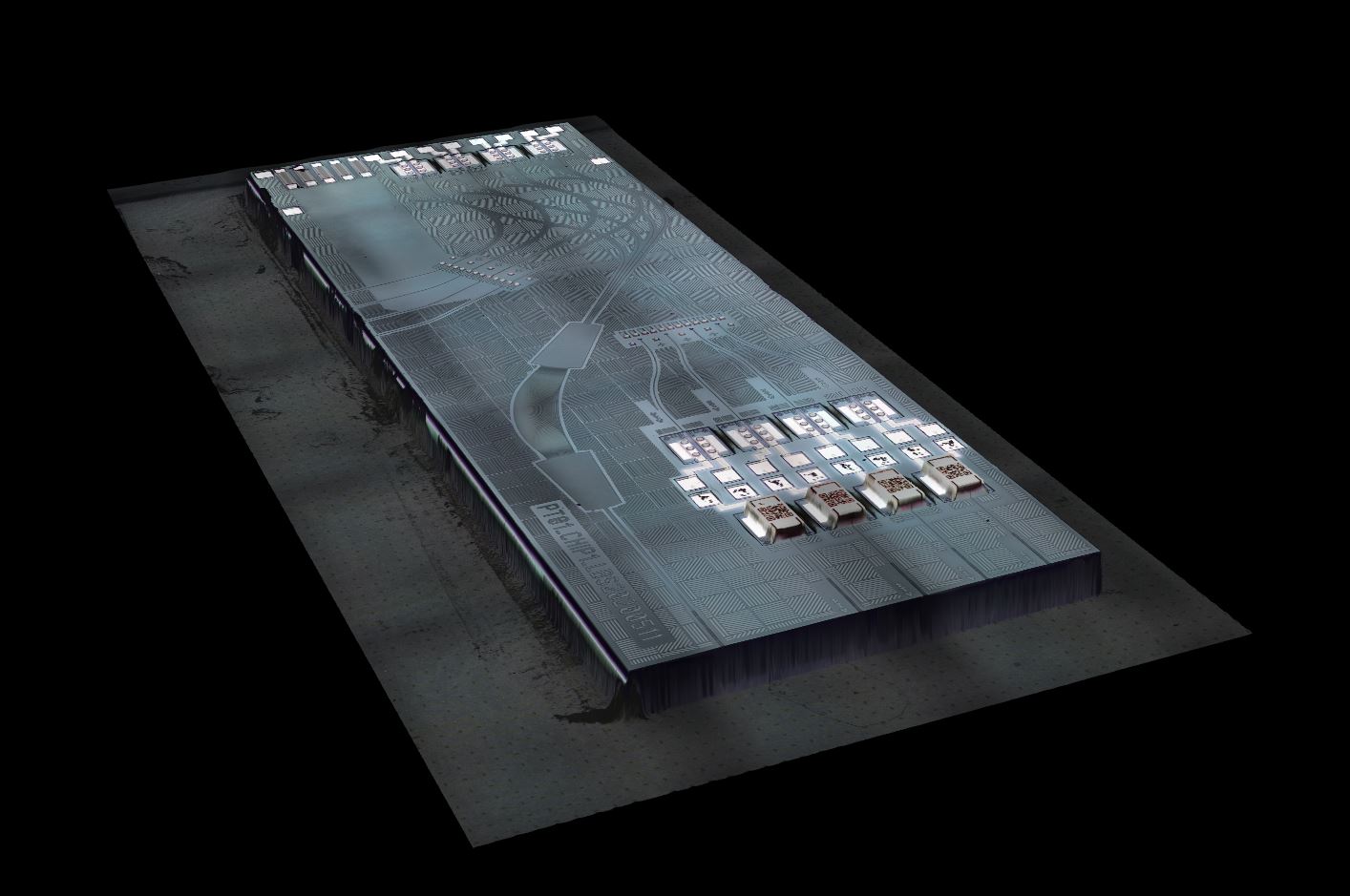
The POET Optical Interposer is a silicon photonics platform that allows active and passive optical components to be assembled onto a single interposer substrate using wafer-level chip-scale processes. This integration approach eliminates many of the fiber-attach and alignment steps that add cost and limit yield in conventional optical module assembly, and it provides a common mechanical and optical interface that can accommodate different chip combinations for different speed targets.
The POET Infinity™ product line targets 800G in both transmit and receive configurations — including 2×FR4, 2×DR4, and DR8 variants — and has received an initial production order valued at over $5 million from a leading systems integrator for AI data center transceiver modules, with shipments targeted for the second half of 2026. [Read more about POET’s “Path to Greater Revenue”.]
The POET Teralight product line extends the same interposer platform to 1.6Tbps, with both transmit and receive optical engine chipsets sampled in 2025. Teralight's 1.6Tbps optical engines have received multiple industry awards, including the Product Innovation Award at the 12th ICCSZ Infostone Awards and an Elite Score of 4.5 from Lightwave Innovation Reviews — one of the highest scores among winning entries in that program's 13th annual edition in 2026.
The platform's daisy-chain architecture means the same fundamental interposer design that enables 800G can be extended to support 1.6T and beyond without requiring a ground-up redesign at the substrate level. For customers designing AI cluster infrastructure that will span multiple upgrade cycles, this architectural continuity directly reduces qualification risk.
QCi Collaboration: Extending the Platform to 3.2T with TFLN Modulator Technology
The most forward-looking dimension of POET's speed-tier strategy is the joint development program with Quantum Computing Inc. (QCi) targeting 3.2Tbps optical engines. POET and QCi are co-developing 400G-per-lane TFLN (thin-film lithium niobate) modulator-based optical engines that would double the fastest currently deployed networking speeds, targeting co-packaged optics (CPO) applications and next-generation AI connectivity.
TFLN modulators offer advantages in electro-optic bandwidth and drive voltage compared to conventional silicon or indium phosphide modulators, making them a compelling candidate for the 400G-per-lane operation required at 3.2T. QCi brings wafer-level TFLN manufacturing process expertise to the collaboration; POET contributes the optical interposer platform. The 3.2T CPO market has been projected by LightCounting to reach approximately $12 billion by 2030, reflecting the long-term strategic importance of this speed tier.
The integration approach — combining QCi's TFLN modulator expertise with the POET Optical Interposer's chip-scale assembly architecture — is consistent with the broader principle underlying POET's platform: A common substrate that can incorporate best-in-class active components from specialized partners rather than requiring all functionality to be monolithically integrated.
How POET Spans Both Pluggable and Co-Packaged Optics Architectures
One of the strategic advantages of the POET Optical Interposer platform is that it is not committed to a single optical packaging architecture. The current 800G and 1.6T product lines primarily address the pluggable transceiver market — the dominant form factor deployed for AI clusters today. Simultaneously, POET's strategy positions the platform for the next architectural generation, where optical engines are integrated directly alongside switch ASICs or GPU packages to reduce electrical interconnect length and power consumption.
POET's external light source (ELS) product family — including the POET Blazar hybrid laser and the POET Starlight™ ELS — is central to the CPO positioning. CPO architectures require external light sources because silicon does not emit light efficiently; a reliable, manufacturable ELS is a prerequisite for CPO at scale. POET demonstrated live operation of both POET Blazar and POET Starlight products at OFC 2026, signaling continued advancement of this part of the company’s portfolio.
POET Blazar is a high-power, multi-channel hybrid laser designed for chip-to-chip links using wafer-level chip-scale technology. POET Starlight is an eight-channel high-power ELS with multi-wavelength capability integrated into a working optical engine targeting an ELSFP module form factor. Together, these products position POET to serve both the pluggable market generating near-term revenue and the CPO market expected to scale significantly later in the decade.
Collaborations with Sivers Semiconductors on next-generation light source co-development, with production targeted by end of 2026, further extend this strategy. POET's approach of partnering with specialized component suppliers — rather than attempting to develop every element of the optical stack internally — is consistent across both the ELS and high-speed engine portions of its portfolio.
A Multi-Partner Ecosystem as Platform Validation
The breadth of POET's collaboration portfolio is itself a form of platform validation. Each partner has independently evaluated the POET Optical Interposer architecture and determined that integrating it into their own product roadmap creates value.
For AI data center operators and system integrators evaluating optical interconnect technology, this ecosystem depth is meaningful. A platform that multiple established companies are building products on top of is less likely to be a single-company engineering effort and more likely to represent a genuinely differentiated foundation for next-generation interconnect.
POET's manufacturing partnerships with Globetronics in Malaysia — with approximately 10,000 square feet of cleanroom space (and growing) and capacity for up to one million optical engines annually — and with NationGate for light source production provide the infrastructure to support volume commitments.
