

The rapid rise of artificial intelligence (AI) workloads is forcing a fundamental redesign of data center interconnects.
Nobody building a hundred-thousand-GPU cluster loses sleep over the chips anymore. The chips are extraordinary. What keeps infrastructure engineers up at night is moving data between them — fast enough, cheaply enough, without melting the building.
That’s the problem photonics is solving, and the window to get positioned is narrowing.
Traditional electrical links and pluggable optical modules are increasingly unable to keep up with the exponential growth in bandwidth demand, power consumption, and latency constraints. As a result, photonics—particularly silicon photonics—has emerged as a critical enabling technology for next-generation AI infrastructure. Three key architectural approaches define this transition: Co-Packaged Optics (CPO), Near-Packaged Optics (NPO), and emerging concepts often referred to as Extra-dense Packaged Optics (XPO). Together, they represent a continuum of integration that is reshaping both hardware design and the broader AI economy.
Defining CPO, NPO, and XPO
Co-Packaged Optics (CPO) is the most tightly integrated approach. It puts the optical engine inside the same package as the switch ASIC or processor. Shrink the electrical path to near-zero and you eliminate most signal loss before it starts. This integration minimizes the electrical distance between compute and optical I/O, dramatically improving bandwidth density and reducing power consumption. By shortening electrical paths to near-zero, CPO reduces signal loss and latency while enabling ultra-high data rates required by AI clusters.
Near-Packaged Optics (NPO) represents an intermediate step. It is the pragmatist’s answer for operators who need efficiency gains now without waiting for full CPO manufacturing readiness. Place the optical engine millimeters from the chip on the same board, capture most of the power and signal integrity improvement, and keep the system modular enough to service and replace at volume. Early deployments show power reductions in the range of 20% to 35% versus conventional pluggable optics. The NPO approach captures many of the efficiency gains of CPO—such as reduced power and improved signal integrity—while maintaining modularity and serviceability.
Extra-dense Packaged Optics (XPO) refers to a newly defined pluggable optics solution that offers very high density packaging with liquid cooling for better thermal management. XPO promises to extend the benefits of pluggable optics (multiple suppliers, plug and play, high serviceability) while matching the density of CPO or NPO solutions. In essence, XPO represents the future trajectory where optics enable flexible scaling across racks, boards, and even entire data centers.
Why Photonics Packaging Matters for AI

AI training and inference workloads require massive data movement between GPUs, memory, and networking fabrics. In modern hyperscale clusters, thousands of accelerators must behave as a single system, creating unprecedented interconnect demands. Electrical copper links struggle at speeds beyond 800 Gb/s because of signal loss, heat generation, and power inefficiency.
Photonics addresses these challenges by transmitting data as light rather than electrical signals. Optical interconnects offer higher bandwidth, lower attenuation over distance, and significantly improved energy efficiency. When combined with advanced packaging approaches like CPO and NPO, photonics enables a step-function improvement in system performance. In fact, industry roadmaps suggest that tightly integrated optical I/O will become essential for future AI infrastructure.
Market Opportunity and Growth Trajectory
The market opportunity for photonics in CPO, NPO, and XPO architectures is substantial and rapidly expanding. Development activity is at an all-time high, with both Broadcom and NVIDIA expected to ship CPO-integrated scale-up platforms in 2027.
Industry forecasts estimate that the likely total addressable market (TAM) scenario puts the AI advanced optical packaging market at $7.6 billion in 2027, growing to $22.8 billion by 2032 at a 24.6% CAGR — with a best-case path currently to $34 billion. The combined market for CPO and NPO modules alone is forecast to reach approximately $5.5 billion by 2027, driven by demand from hyperscale data centers and AI applications. Those numbers capture the switch and networking layer. They say relatively little about what happens when this integration pressure moves into GPUs, memory subsystems, and every other component that touches AI workloads. The TAM cited today is a floor, not a ceiling.
As AI models scale toward trillions of parameters and real-time inference becomes ubiquitous, new markets emerge for photonic integrated circuits (PICs), advanced packaging technologies, optical fiber innovations, and co-design software tools.
Efficiency and Cost Advantages of Advanced Packaging Options
One of the most important drivers behind CPO, NPO, and XPO adoption is energy efficiency. Data centers already consume significant amounts of electricity, and interconnect power adds to that total. By reducing the distance electrical signals must travel—and in some cases eliminating them entirely—photonic integration can lower per-bit energy consumption.
CPO offers the highest efficiency gains, but at the cost of increased complexity in manufacturing, thermal management, and maintenance. NPO provides a more balanced trade-off, enabling incremental improvements without requiring a complete redesign of system architecture. XPO, meanwhile, promises to extend the benefits of pluggable optics while offering the density requirements similar to CPO and NPO.
Cost savings also emerge from reduced component counts and simplified system design. For example, eliminating high-power digital signal processors (DSPs) and long copper traces can reduce both capital expenditures and failure rates. Over time, economies of scale in silicon photonics manufacturing—leveraging existing CMOS processes, or the “semiconductorization of photonics”, if you will—are expected to further drive down costs.
The Role POET Plays in CPO, NPO, and XPO
POET Technologies’ two external light source (ELS) platforms—POET Blazar™ and POET Starlight™— directly address the core challenges of delivering scalable, manufacturable light for next-generation chip-scale optical architectures, including CPO and NPO.
At the heart of both solutions is the POET Optical Interposer™ platform, which integrates lasers, waveguides, and passive optical components at wafer scale. This design is critical for CPO, NPO, and XPO architectures, which increasingly are demanding tightly integrated, chip-adjacent or chip-scale optical connectivity. These architectures require compact, efficient, and cost-effective external light sources that can be manufactured in high volume.
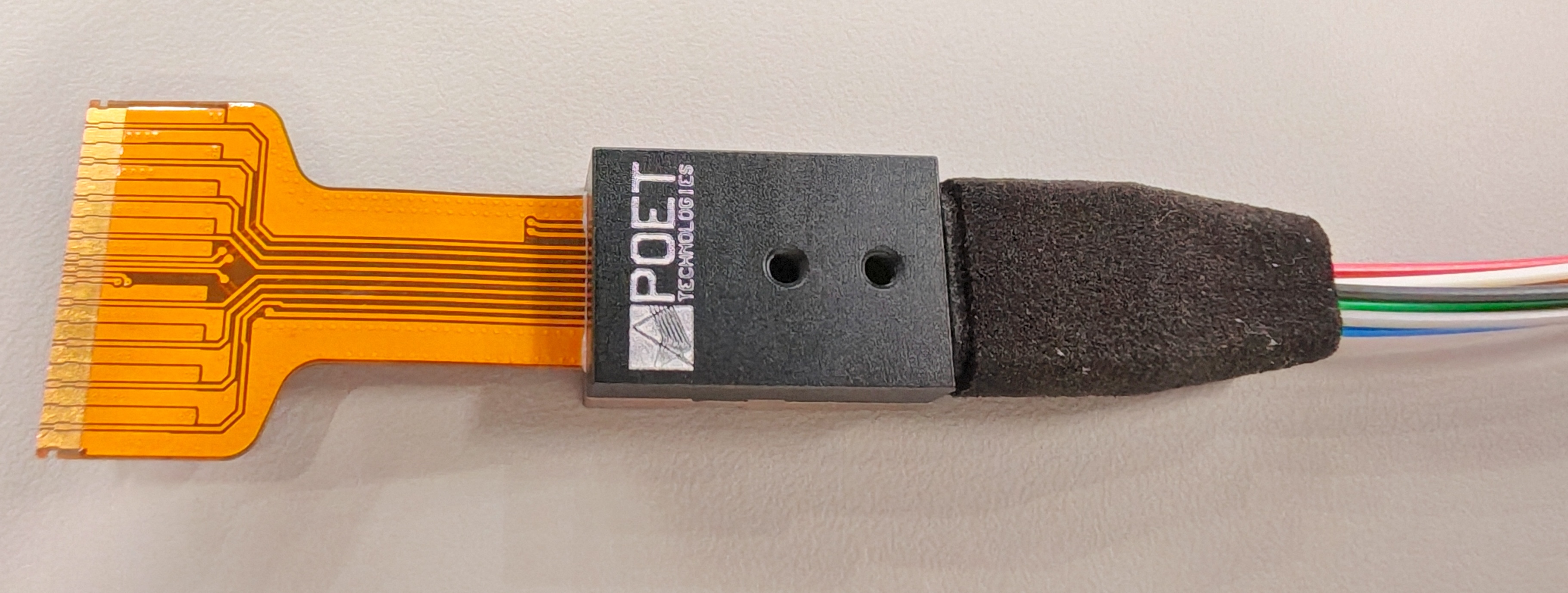
POET Starlight represents a commercially ready, packaged light engine designed specifically for integration into AI and silicon photonics ecosystems. Starlight combines high-power continuous-wave lasers with passive components such as multiplexers, demultiplexers, splitters, and waveguides directly into the interposer. This high level of integration allows Starlight to deliver multi-wavelength, multi-channel light from a compact footprint, enabling seamless connection to ASICs and photonic chips used in CPO and NPO systems. Importantly, its wafer-scale passive alignment and use of known-good laser dies significantly reduce assembly complexity and cost—by as much as 75% compared to traditional solutions—while supporting high-volume manufacturing.
POET Blazar, by contrast, is a next-generation, high-performance ELS designed to push scalability and performance for future CPO, NPO, and XPO architectures. Blazar is a high-power, multi-channel hybrid laser built using wafer-level chip-scale packaging, which enhances reliability while dramatically lowering cost and improving manufacturability. It is specifically engineered to support high-bandwidth, chip-to-chip optical interconnects—an essential requirement for disaggregated AI compute fabrics. By reducing dependence on traditional distributed feedback (DFB) laser arrays and improving the utilization of indium phosphide (InP) materials, Blazar enables better supply scalability and cost efficiency, both of which are critical for hyperscale deployment.
Together, Starlight and Blazar form a complementary duo that represents the cornerstone of POET’s ELS portfolio. They span current and future needs of optical I/O architectures. Starlight delivers a proven, production-ready solution for near-term deployment in CPO and NPO systems, while Blazar introduces a path toward higher power, higher density, and more scalable light sources required for next-generation AI optical interconnects.
These solutions eliminate key bottlenecks in optical packaging—particularly laser alignment, thermal management, and cost—making them commercially viable enablers of chip-scale photonics.
Innovation Opportunities
Despite its promise, the transition to photonics is not without challenges. Manufacturing yields, packaging precision, and fiber alignment all require new engineering solutions. Additionally, standardization and interoperability remain ongoing concerns.
These challenges, however, represent opportunities for innovation. Companies that can develop robust packaging techniques, efficient optical coupling methods, or scalable photonic chiplet architectures stand to capture significant commercial interest.
The promise is great. CPO, NPO, and XPO define a spectrum of photonic integration strategies that are rapidly transforming AI infrastructure. From near-term deployments of NPO and XPO to long-term visions of fully integrated CPO systems, photonics is becoming central to achieving the performance, efficiency, and scalability required by next-generation AI workloads.
For hardware manufacturers, the opportunity is clear: Those who embrace photonics-driven architectures will unlock faster, more energy-efficient systems—and gain a decisive advantage in the increasingly competitive AI landscape.
